


What really is success?




At a time when there is much talk about excellent grades, achievements, and academic success, it makes sense to ask whether success can really be measured only by A's, titles, position, or bank account numbers.
In my work, I often meet people who, at first glance, have everything that would make them successful: a good job, a solid income, and a well-defined career path. Yet they are not satisfied. They are looking for new paths, especially those where they can do something that is close to them and in which they see meaning.
So what is success? Excellent grades? A well-paying job? Your own business? Financial security? Work that makes you happy and finds useful?

Grades only show part of the ability
To be absolutely clear – school is definitely of utmost importance. A good education can open many doors and provide an important foundation for the future. Specific knowledge is one of the key elements of any truly successful company. At the same time, access to knowledge is extremely open today, so we can and must constantly acquire it in many other ways besides school.
The problem arises when we judge an individual's worth and their chances for future success primarily through grades, as these only show a certain part of their abilities, such as knowledge, discipline, perseverance, and the ability to achieve goals within a certain system. They do not show many things that are of utmost importance in life and entrepreneurship.
So what is it that counts so much in both entrepreneurship and everyday life? Let's help ourselves with the following questions: Does he know how to recognize and exploit opportunities? Does he find himself in unpredictable situations? Does he think creatively? Does he look for solutions to problems he perceives in the market? Does he have passions and hobbies that make him willing to go a step further? Does he look for a higher meaning in his work besides earning money? Is he willing to take responsibility and make decisions?
These are qualities that are difficult to capture with a school grade, but they are essential for entrepreneurial success. Most of the time, an entrepreneur is not solving equations with one, but with at least two unknowns. Nevertheless, they have to make decisions.
Maybe that's why we get to the point where people say, "He wasn't anything special in school, but now he's a very successful entrepreneur." That doesn't mean that school isn't important. It just means that academic success doesn't capture all abilities.
Success doesn't have a single definition.
When we talk about what success is, we are looking for a definition of something very personal. Unfortunately or fortunately, there is no universal answer. Success means something different to everyone: financial stability, company growth, job satisfaction, greater independence or a positive impact on the environment. Above all, success is not just the end result.
However, we can notice a common denominator among people who achieve good results in the long run and are satisfied with it - they do their work with passion, dedication and commitment, and they see meaning in it.
On the other hand, we often see people who meet all the external criteria for success, but do not see any real meaning in their work. Motivation decreases over time, work becomes a burden, and the risk of burnout increases. This is why we encounter people who appear successful on the outside, but do not feel that way themselves.
Meaning helps to persevere, but it is not enough
Some of them choose the entrepreneurial path because they see it as an opportunity to devote themselves to work that is closer to them. If they also have entrepreneurial qualities that the environment has not previously recognized or adequately valued, their chances of success may be greater. Of course, this does not change the fact that they face numerous obstacles, risks and uncertainty.
The impact that meaningful work has on individual success is not magic or coincidence. It is a fairly simple, but often overlooked mechanism. When we do something that is close to us, we are willing to invest more time and energy. We are more likely to persevere even when obstacles inevitably arise. And it is this extra effort that eventually brings the difference in results or success.
I am in no way idealizing the often-heard advice that everyone should simply follow their passion. Passion alone is not enough. Results and success require hard work, knowledge, discipline, perseverance and much more. Likewise, entrepreneurship is not an automatic path to satisfaction, as in addition to the advantages it also brings uncertainty, responsibility, financial risks and a lot of burden. However, a sense of meaning plays an important role, as it makes even a difficult path worth the effort.
We need to recognize different paths to success
As a society, we need to be able to recognize different talents and different forms of success. Some are evident in school, while many are harder to measure, but they have a huge impact on an individual's path.
If we can recognize and encourage this potential, we enable people to better develop their abilities and direct them towards work in which they see meaning and can achieve more. This not only benefits the individual, but also society as a whole.
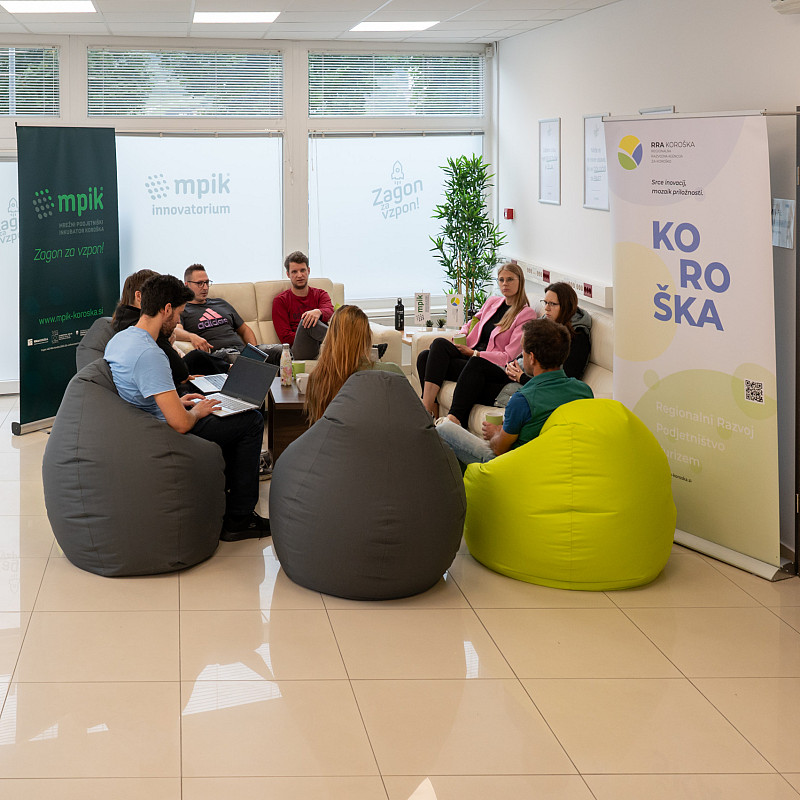
If you are looking for entrepreneurial support and assistance on the path to realizing your potential, we at MPIK, which operates within RRA Koroška, are happy to help. More information can be found at www.rra-koroska.si/mpik .
Avtor: Jure Knez, RRA Koroška d.o.o. – Mrežni podjetniški inkubator Koroška
Sorodne objave










Koroška e-news in your inbox!